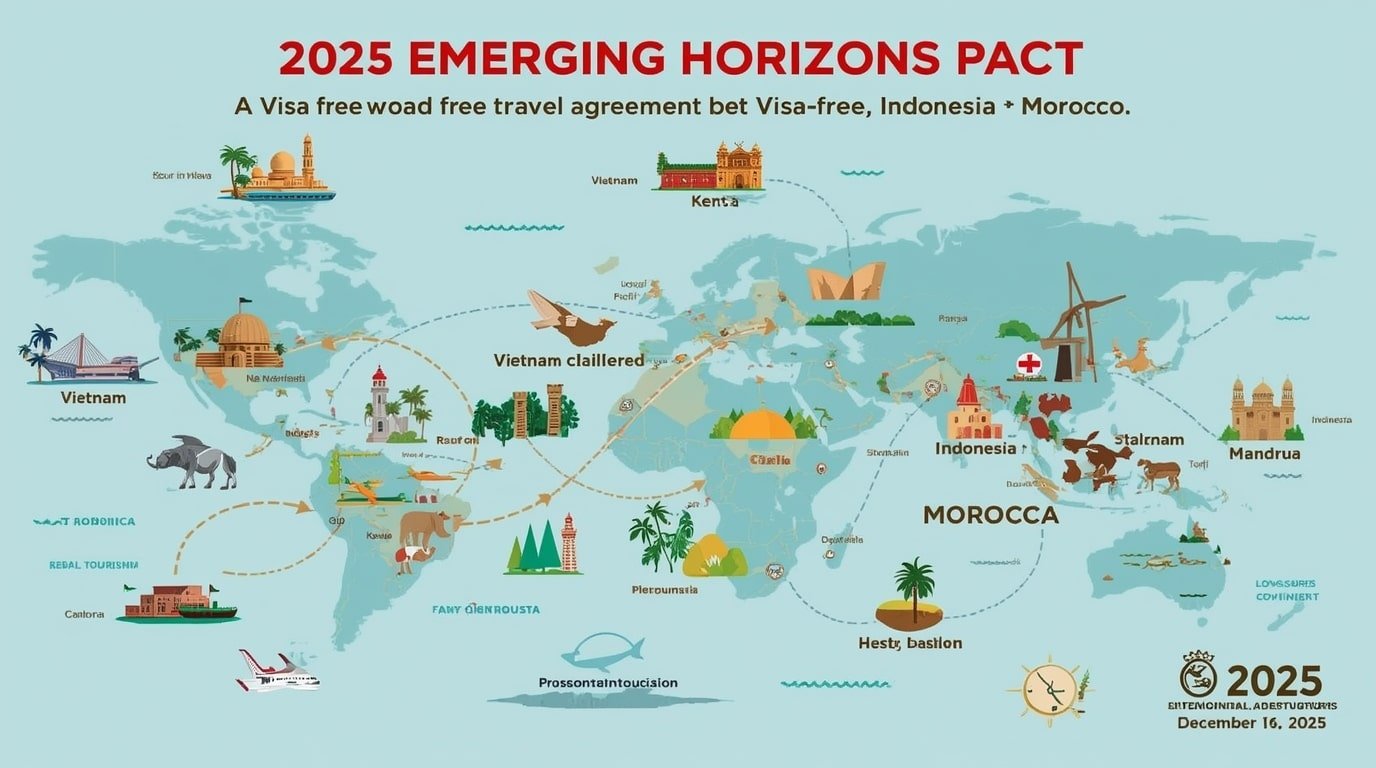
In a historic development that will transform global tourism, authorities in various emerging countries announced a new visa-free travel disclosure, expected to increase the number of cross-continental tourists.
The agreement, announced on December 15, 2025, during a virtual summit organised by the United Nations World Tourism Organisation, involves key players such as Vietnam, Kenya, Indonesia, and Morocco. This program will help to remove bureaucracy for travellers, leading to economic development and cultural interchange between these fast-emerging destinations.
The corridor, which has been christened the Emerging Horizons Pact, enables the citizens of countries involved to move freely without the need for a visa for up to 90 days to visit and tour the country, attend business conferences and see relatives.
Beginning January 1, 2026, people with qualified passports will be able to present their documents at points of entry without the usual visa application, which is often associated with long processing times and fees. This is being developed in response to a post-pandemic boom in demand for authentic, off-the-beaten-path experiences, with these countries recording unprecedented visitor numbers in recent years.
The Information on the Groundbreaking Agreement
The pact negotiations were initiated in early 2025 and were motivated by the desire to have sustainable tourism and economic diversification. Vietnam, with its breathtaking sceneries, Ha Long Bay and Mekong Delta, among others, has been lobbying to gain access to markets in Africa with ease.
Kenya, which boasts iconic safaris and coastal beaches, hopes to attract even more Asian tourists to diversify beyond European tourists. The various islands of Indonesia and the mixture of ages-old medinas and the desert adventure of Morocco complete the circle, forming a link between the Asian and African continents.
Within the conditions, travellers will be subjected to the usual health and safety procedures, such as documentation of vaccination when necessary and listing through a digital application to monitor contacts.
The agreement also includes provisions for joint marketing campaigns, including shared promotional videos and travel fairs, to draw attention to the special attractions. As an example, a Kenyan safari may easily tie into a Vietnamese cultural tour, and partner airlines may promote discounted connection flights.
It will boost substantially, according to economic analysts. In these countries, tourism boosts GDP by more than 10%, and the corridor has the potential to spur billions in value by 2030. Street food vendors in Hanoi or artisan shops in Marrakech are examples of small businesses that will benefit from increased foot traffic.
Environmental protection is integrated, and policies limiting visitor numbers in sensitive regions, such as Kenya’s Maasai Mara or Indonesia’s Komodo National Park, are established to avoid overtourism.
Responses of Leaders and Industry Experts
Leaders welcomed the announcement as a move towards inclusion in global mobility. According to the statement by Vietnamese Prime Minister Pham Minh Chinh at the summit, the agreement will open the door to friendship and prosperity, allowing the peoples of both nations to learn about one another’s rich heritages without hindrance. Kenyan President William Ruto reflected on this, saying that it integrates with the African Agenda 2063 of continental integration, and that he should extend bridges to Asia.
The tourism industry’s stakeholders are also enthusiastic. According to executives from leading hotel chains such as Accor and Marriott, bookings are expected to increase by 20-30%, particularly among millennials, who are more likely to choose adventure travel. Social media travel influencers have already started talking about “corridor hopping” itineraries, which would include a combination of Bali beaches and Moroccan souks.
Nevertheless, there are still some concerns. Those opposing this fear the strains that are likely to be placed on infrastructure by the growth of these emerging economies, and they demand investment in airports and transport infrastructure. Security experts also demand data-sharing to reduce risks such as illegal migration.
Global Travel Implications in Future
This visa-free space has the potential to motivate similar initiatives worldwide, marking the end of closed borders in the tourist industry. With climate change and political tensions, travel patterns are likely to change; therefore, such agreements are a strength when they foster South-South collaboration. To ordinary travellers, it implies cheaper, impulsive journeys, maybe a last-minute flight to Nairobi, Indonesia, to go on a wildlife safari.
Altogether, the Emerging Horizons Pact is a courageous period in the history of tourism, as a unification of countries in the common perspective of open-door exploration. The world is watching how this corridor is changing not only economies but also the way we communicate across continents as implementation rolls out.


