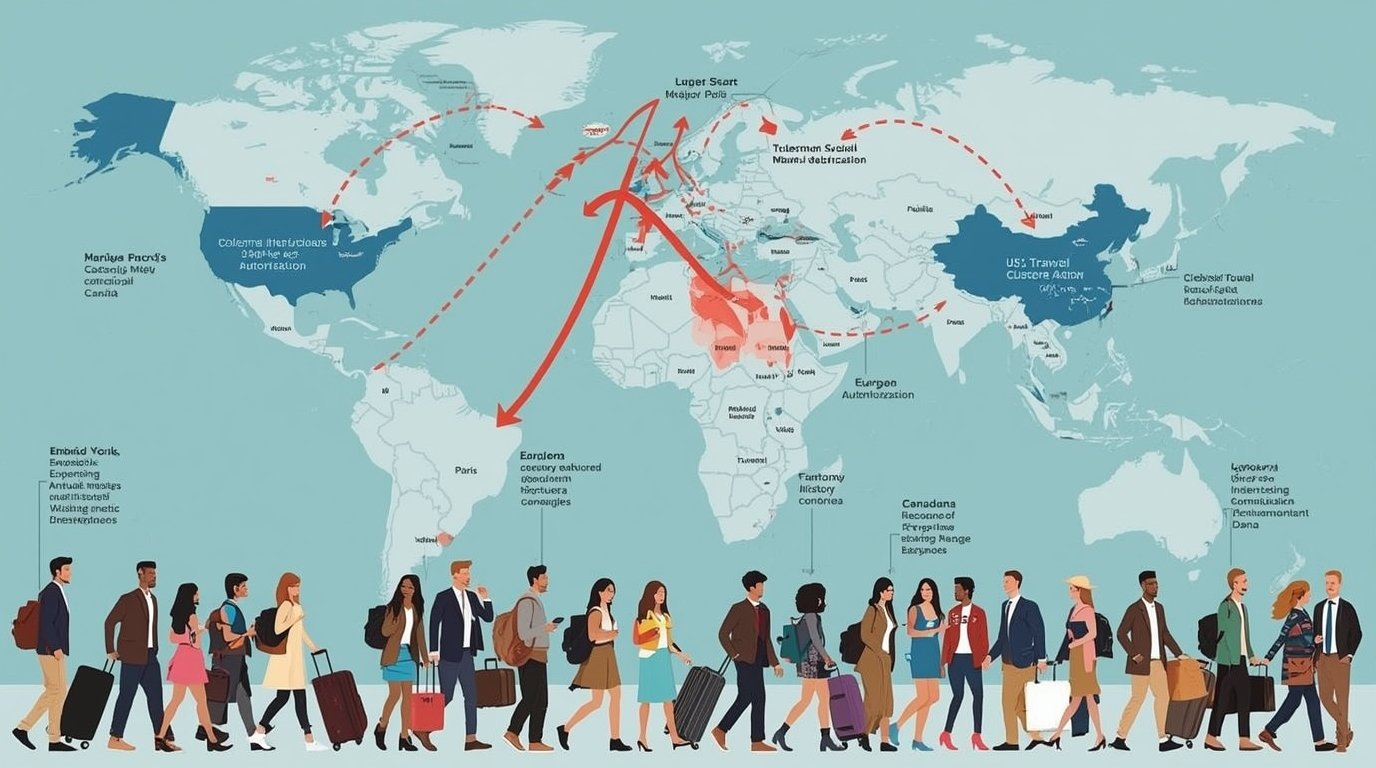
The United States has issued a new policy that requires the collection of a substantial amount of data on visitors, which has elicited a furore among many millions of tourists travelling to Europe and Asia, causing them to shift their plans towards friendlier places.
Expressed in the context of the increased security risk, the alterations in the Electronic System of Travel Authorisation have sparked debates of privacy and convenience, transforming the holiday and business travel trend as the year-end season nears.
In its policy, outlined in a new Federal Register notice, the policy mandates travellers of 42 Visa Waiver Program countries to provide social media history up to a five-year history, telephone numbers in the last five years and two decades of email histories. This growth is based on an executive order that is to enhance the screening of national security.
Social media disclosures, which were previously voluntary, are now compulsory, and there are further requests for metadata of the uploaded photographs, detailed background details about a family, and even biometric data such as fingerprints and iris scans. The authorities say that such steps will allow conducting background checks to ward off threats, yet critics fear the overreach that will scare away both casual tourists and businesspeople.
The Policy’s Core Changes
At the centre of the overhaul is the Electronic System of Travel Authorisation in the Visa Waiver program that has enabled entry with no visa on short stays since its inception. This is one of the major revisions that was introduced with high-value data fields, which comprise the birthplaces of family members and past contacts.
It is in the process of a 60 day public comment period after which it can be implemented. Although approvals have always been close to instant, the increased scrutiny can result in a time lag, turning the formerly smooth process into an invasive experience. The needs are also ripple-effected to close allies, such as citizens of Canada, the United Kingdom, Germany, Japan, Mexico, and France, among others.
Increasing Privacy Concerns and Passengers’ Outrage
Customers are complaining bitterly, accusing them of espionage and misappropriation of information. The activists of civil rights suggest that the process of requiring social media history may leave out those who have politically sensitive posts or those who are not familiar with online platforms. In cases of families and visitors who are older, it is practical to put together years of contact information.
Adding to soaring flight prices and increased immigration enforcement, the policy contributes to the perception of the US as being hostile. Most Europeans who were used to hassle-free trips across the ocean find the process unfriendly as they now prefer intra-continental escapes that do not require such intrusions.
Boom in Rival Destinations
This means that such nations as Canada, the United Kingdom, Germany, Japan, Mexico, France, Spain, and Italy are undergoing a surprising spurt in tourism. Europeans are swarming to Paris, Rome, and Barcelona instead of New York or Los Angeles, due to shorter and cheaper flights and easy entry.
Although Canada is a neighbour of the US, it is becoming a major beneficiary as the visitors shift their itineraries to visit Vancouver or Toronto. According to industry experts, the Asia-Pacific travellers are also shifting towards Japan and Mexico in search of cultural richness experiences without the bureaucratic hassles. This change comes at a very opportune time, especially during the holiday season when families are shifting their focus to ease, rather than the US hot spots.
Critical Statistics Emphasise the Exodus
The early 2025 data point to drastic downfalls in the US inbound tourism. The United Kingdom arrivals fell by 17% in the first quarter after the nation recorded just under six million visitors in 2024. The same case applies in Germany at 12%, Japan at 10% and Canada at 16.8%.
The whole of Western Europe experienced a 17% decline, which indicated a wider exodus. Although cultural relationships continue resilient in some Canadian travellers to the US, the increasing cost of living and equal airfare are hastening the diversion.
It has been projected that the US may lose millions of tourists every year as trends continue to accelerate, giving economic advantages to competitors in terms of more hotel bookings, dining, and attractions income.
Consequences of the Travel Industry
The repercussion is not confined to the national borders, and this could even halt the growth of US tourism and increase competitors. The airlines and hospitality industries in the countries that are affected are adjusting by increasing their services by offering low-cost packages and simplified visas.
There are increasing calls to point the US back on track, perhaps by reducing the demands or focusing on security without upsetting the allies. With the policy discussion underway, the world travel map is being redrawn, highlighting the role of the national choices in changing the international movements rather quickly.
This changing narrative also brings out the fragility of the balance between security and openness in a globalised world, as privacy becomes a central element in the destination decision-making. The long-term effect is yet to be noticed as 2025 approaches, but the diversion of the wanderlust in the immediate is impossible to ignore.